Norric AI / AI-native Enterprise Platform + B2B SaaS
The answer exists. It's just buried in last quarter's email.
Norric AI is an AI-native operating system that helps private market firms respond to institutional DDQ and RFP requests. I designed a system where AI supports speed and consistency, while humans retain ownership over judgment and risk.
Role
Lead Product Designer & AI Product Strategist
Duration
Sep – Dec 2025
Company
Norric
Collaborator
CEO, Front/Back-end Developer,
6 Product design interns
Skills
Product Shaping
IA
Interaction Design
Design System
AI-assisted Review Experience
WHAT'S A DDQ?
DDQ (Due Diligence Questionnaire) is a standardized set of questions institutional investors send to fund managers before committing capital—covering firm history, investment strategy, compliance, risk management, and more.
Think of it as a 100+ question exam that firms must complete perfectly, repeatedly, every quarter. This project was about designing boundaries, not full automation for its own sake.

MY ROLE & CONTRIBUTIONS
Product Strategy
Shaped product direction with CEO, defined core workflows and AI boundaries
Information Architecture
Designed system structure for DDQ workspace, repository, and AI agent
Interaction Design
Created response builder, matching system, and review flows
Design System
Built component library for consistent enterprise experience
AI Experience
Defined where AI helps and where humans decide
Overview
Same questions. Every quarter. Answers buried everywhere.
The questions aren't hard. 60% are identical across investors. But finding where you answered them last time? That's where teams lose hundreds of hours.
I designed Norric to make past answers instantly findable, progress always visible, and accountability crystal clear—while keeping final decisions in human hands.
PROJECT CONTEXT
Users
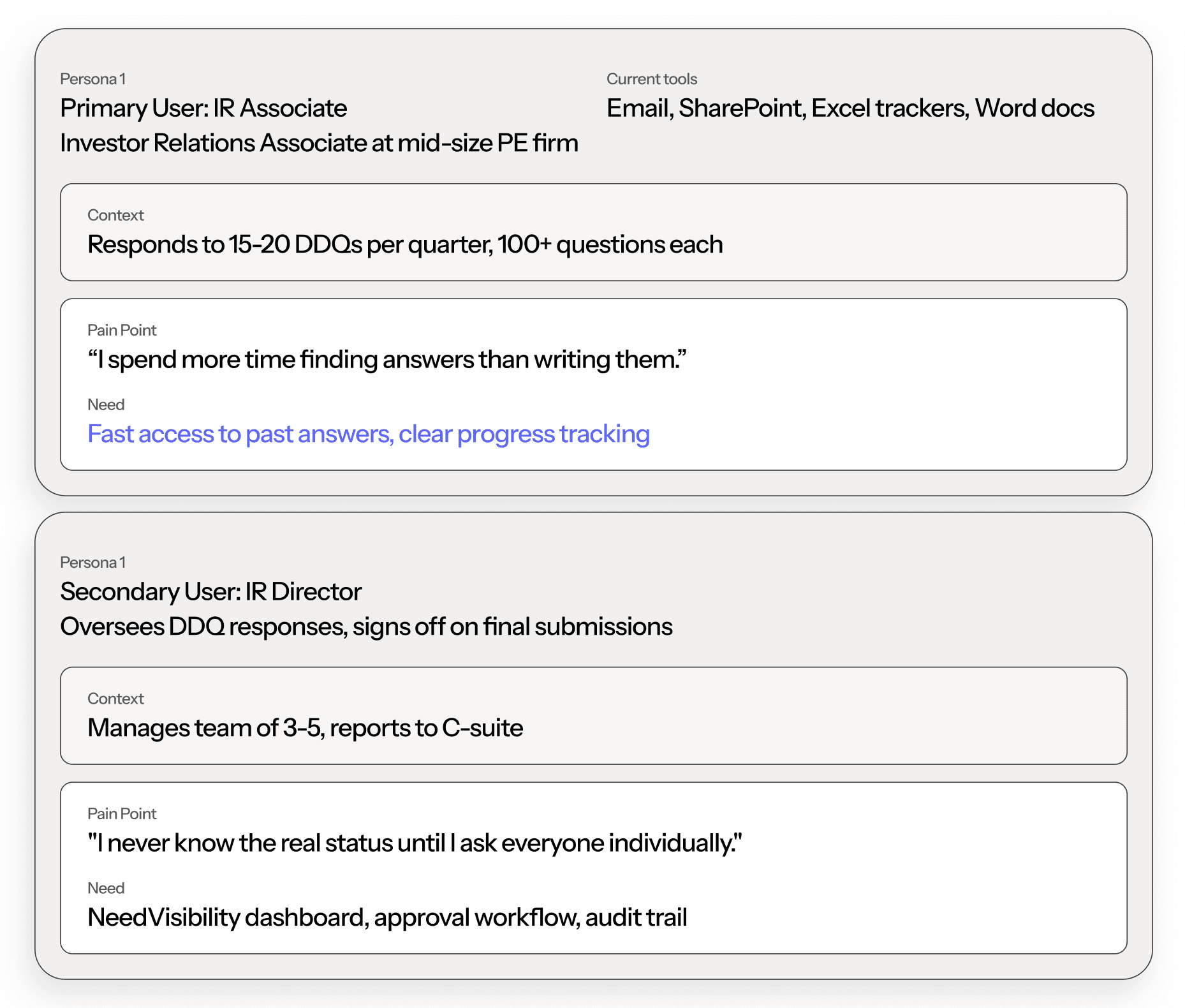
Investor Relations (IR) teams at PE/VC firms responding to 10-50+ DDQs per quarter
Stakeholders
Institutional investors (pension funds, endowments, sovereign wealth funds)
The Reality
60% of questions repeat; answers scattered across platforms
The Goal
One place to manage DDQs from start to finish
The Constraint
AI assists, but humans must own final decisions (legal liability)
The problem
Writing the answer takes 5 minutes. Finding the old one takes 30.
Receive DDQ
PDF arrives via email, manually parsed question by question
Find past answers
Search emails, SharePoint, Slack, ask colleagues
Draft response
Copy-paste from old docs, hope it's still accurate
Review
Email threads, file confusion, "which one is final?"
Submit
Manual export, no audit trail of who approved what
Painpoint
60% of questions repeat
Impact
Yet teams rewrite answers without access to prior versions
Painpoint
Answers scattered everywhere, Hours lost to searching
Impact
Teams rewrite the same answers without access to prior versions
Painpoint
Progress is invisible
Impact
More time hunting for old answers than writing new ones
Painpoint
Deadline collisions
Impact
Multiple DDQs due simultaneously, every quarter
WHAT'S MISSING
Solution
One workspace. Findable answers. Visible progress. Human sign-off.
I didn't redesign how investors ask. I redesigned how teams find, write, review, and submit.
Core flows
01 Drag. Drop. Searchable.

From inbox to answers in seconds.
Teams drag incoming DDQs into a single searchable repository. AI auto-matches each question to past responses, flagging exact matches, high-confidence suggestions, and gaps that need fresh answers.
02 Found by AI. Approved by you.

AI flags issues. You decide what's next.
Instead of leaving users to manually audit everything, the system highlights the issue and suggests next steps: review the document, compare with last year's submission, and update the answer.
03 Question-level ownership

The right expert on every answer.
Route each question to legal, compliance, ops, or IR — not the whole document. Everyone knows exactly what's theirs.
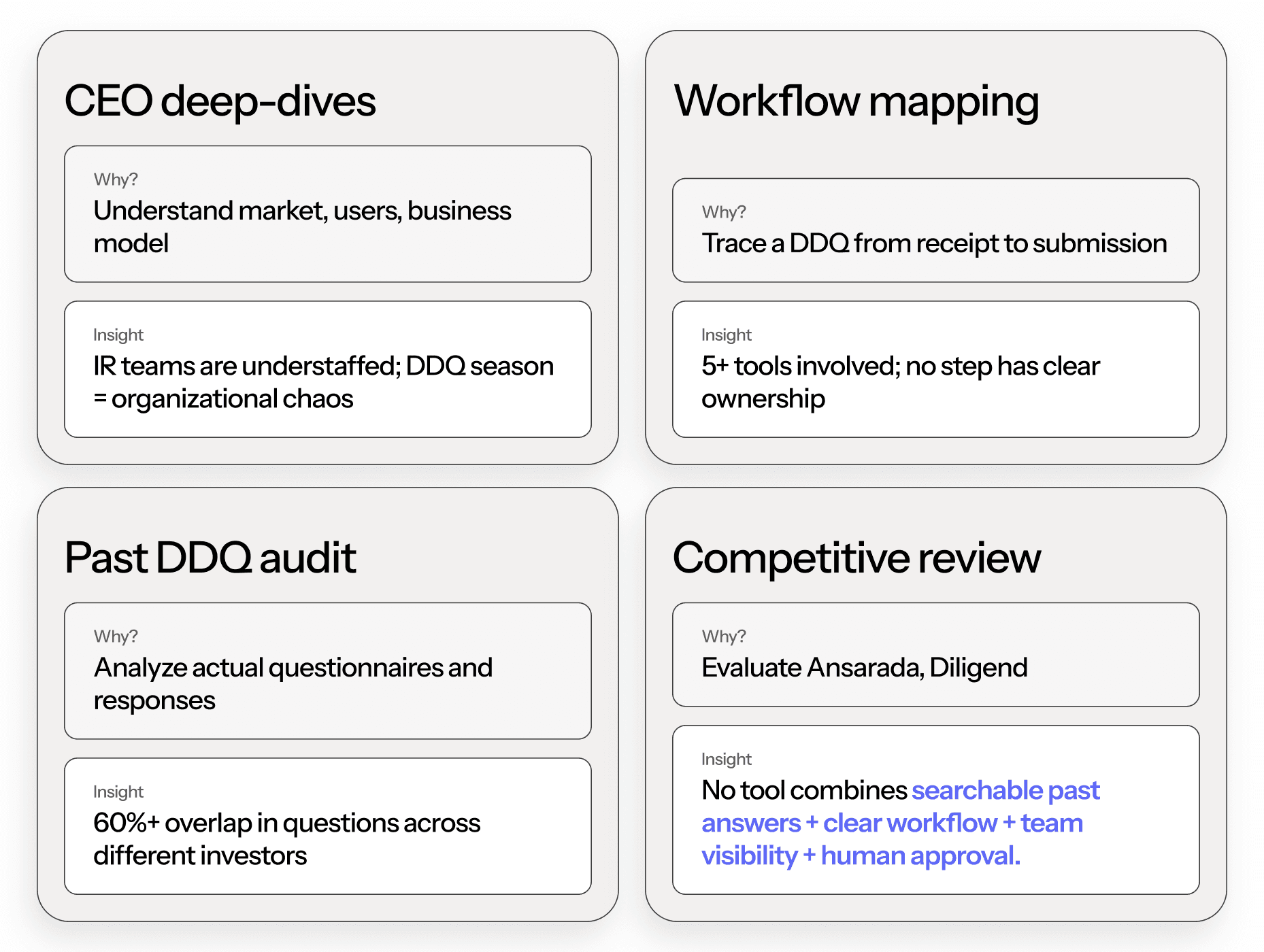
Research
Before solutions, I needed to understand the workflow that doesn't work.
The initial brief was "add AI to DDQ workflows." But I needed to understand: Where does the current process actually break down? What do IR teams need vs. what do they say they need?
What I Did
User Persona
Design Decisions
Why I made the choices I made
1. Why does AI suggest instead of auto-fill?
Legal liability
Firms must own their submitted responses
Context matters
Past answers may be outdated or situation-specific
Trust takes time
Users need to verify before trusting AI suggestions
-> AI surfaces past answers with confidence levels. Humans always make the final call.
2. Why confidence levels (Exact / High / Low)?
Not all matches are equal
"Exact" = same investor, same question. "High" = similar but needs checking.
Users need to calibrate trust
Knowing confidence helps them decide when to verify
-> Visual confidence badges on every match. Users learn to trust "Exact" and double-check "High."
3. Why can't AI auto-submit?
Compliance requirements
Institutional investors require human accountability
Risk management
One wrong answer can damage firm reputation
-> AI assists drafting. Human clicks "Approve" and "Submit." Accountability is never hidden.
4. Why real-time progress instead of status reports?
Multiple DDQs at once
Teams need to see all projects simultaneously
Status meetings waste time
Dashboard eliminates "what's the status?" conversations
-> Dashboard shows all DDQs, progress per question, assignees, and blockers. Always current.
AI Boundaries
Where AI Stops
The easy part was deciding where AI helps. The hard part was deciding where it shouldn't.
Fund managers have legal liability for DDQ responses. Investors require human accountability. If AI auto-submitted an incorrect answer, the consequences would be severe—regulatory issues, damaged relationships, potential lawsuits.
The Line I Drew:
Parse incoming questions
Verify parsing is accurate
Match to past answers
Choose which answer to use
Show confidence levels
Decide when to trust the match
Draft suggested text
Edit and finalize wording
Track progress
Own the approval
—
Click submit
Key Design Decision:
When a response moves to "Review" status, AI assistance fades. The final stages are human-only. This keeps accountability visible, not hidden behind automation.
Design Process - Iteration
What didn't work, and why we changed it
V1: AI in Charge, Workflow Scattered
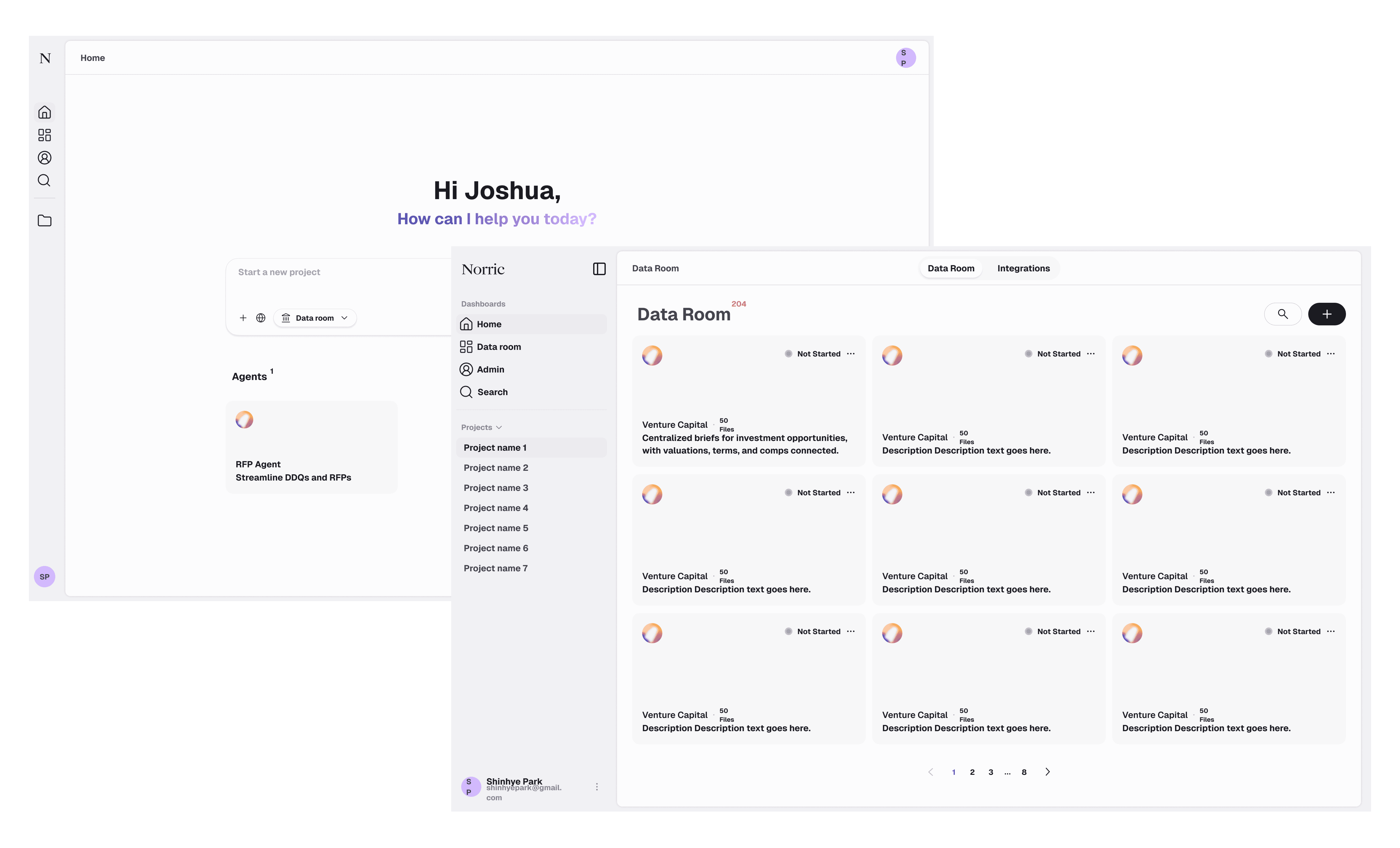
What we built
A home screen that opened directly with an AI agent with the Data Room, project navigation, and answer workspace all living as separate surfaces.
Why it failed
The AI greeted users before they even knew what they were working on. And once they started, the three core actions (finding documents, matching past answers, and writing responses) existed in completely different places. Users had to mentally stitch the workflow together themselves.
Insight
AI should support the workflow, not own the entry point.
V2: Editor and Agent Living Apart
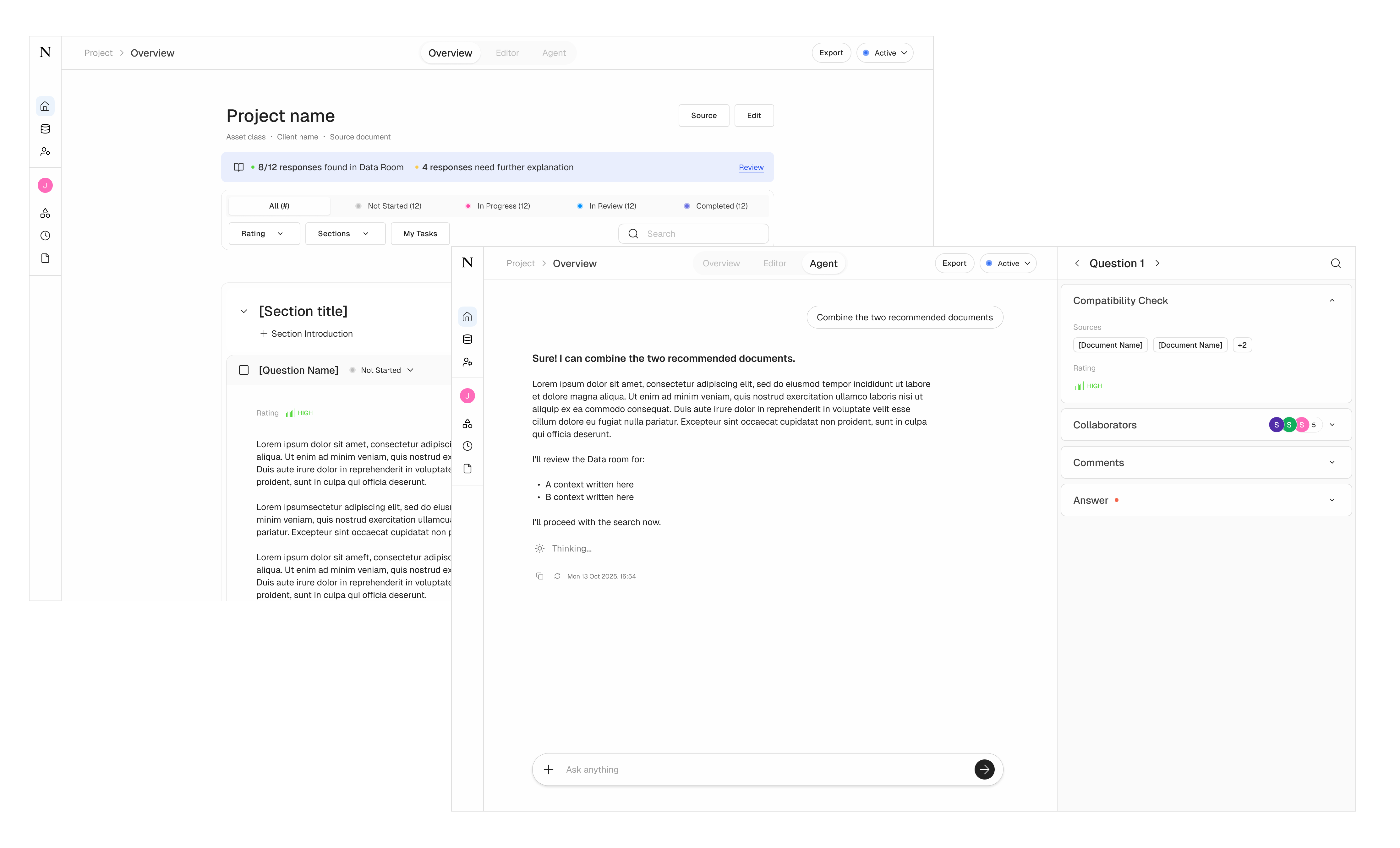
What we built
A project workspace with status tracking and question overview, plus a separate Agent tab where users could ask AI for help, with collaboration details (sources, rating, collaborators, comments) surfaced inside the agent panel.
Why it failed
Editing a response and talking to the AI were two different screens. Users had to switch tabs mid-thought. And placing collaboration info inside the agent panel meant people were jumping into AI mode just to check who was working on what, a completely different job to be done.
Insight
Don't make users switch contexts to finish one task.
V3 (Final): One Surface, Human in Control
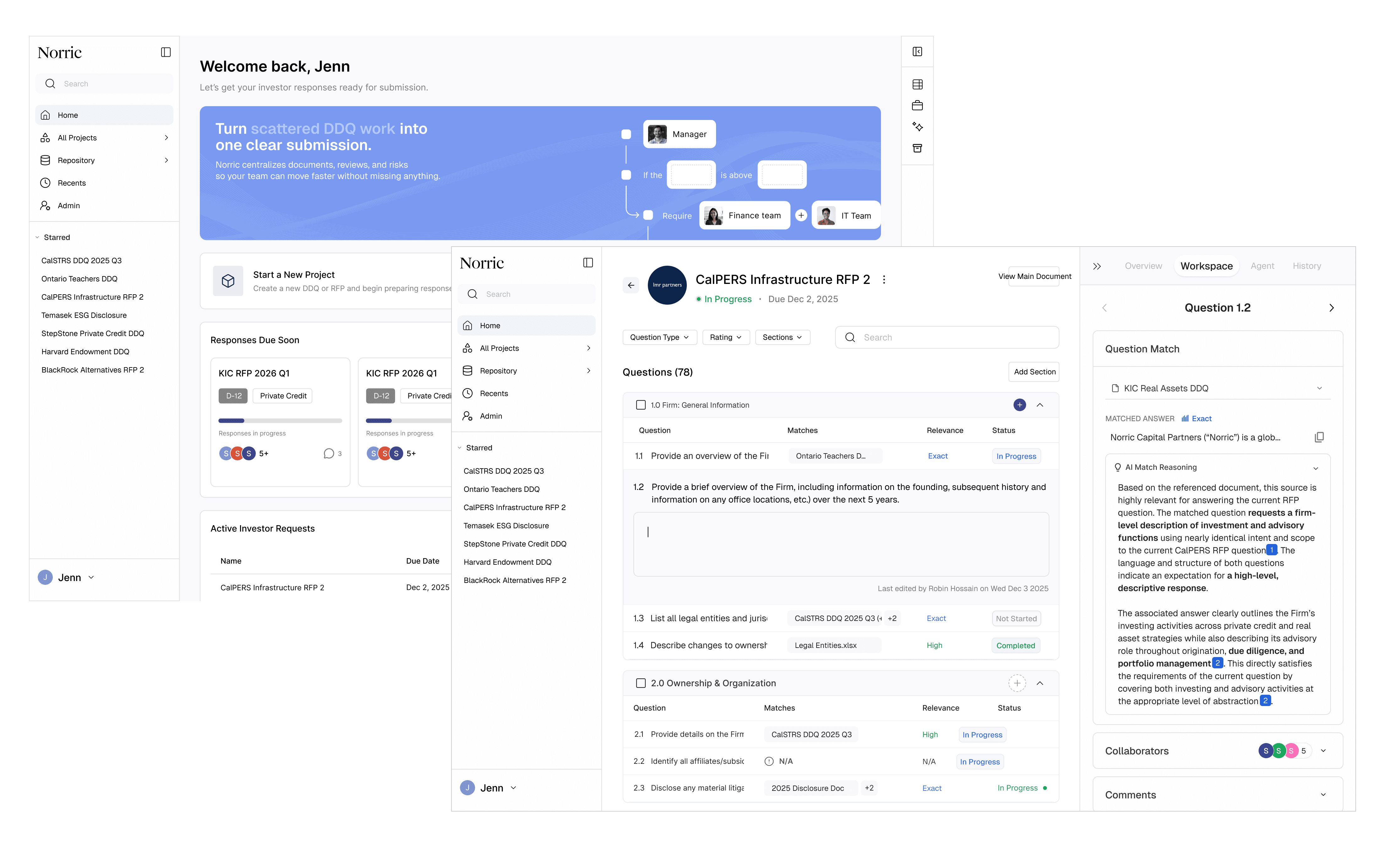
What we built
A unified dashboard showing all active DDQs, due dates, and team progress at a glance, then a single workspace where users write responses with AI match suggestions, source documents, and collaborator status all visible side by side.
Why it worked
Users no longer had to switch surfaces mid-task.
While writing a response, AI surfaces matched answers from the repository, but the user decides whether to use them. The source documents behind each match are visible inline, so trust is built into the flow.
Collaboration status sits in the same panel, so "who's handling this?" is answered without leaving the screen.
Impact
DDQ throughput
Baseline pace
60% more questions completed
Time to find past answer
30+ min searching
<30 sec with AI match
Approval audit trail
Buried in email
Built into system
Progress visibility
Ask via email
Real-time dashboard
Looking back
What I learned from Norric AI.
The real problem hides behind the obvious one
"Add AI" was the brief. "Make knowledge findable" was the actual problem.
Designing boundaries is harder than designing features
Knowing where AI should stop required more thought than where it should help.
Visibility is underrated
A simple progress dashboard eliminated hours of status meetings.